Two · While it runs
You should be able to go inside.
Set the night up, shut the door, and let the Mac do the watching. It knows the difference between a night going wrong and a night that has simply finished.
Focus you can check
The commonest complaint in the hobby is auto-focus reporting success while the scope sits miles out. Earendel runs the telescope's autofocus, then measures the stars instead of trusting the word “success”. It compares them with how tonight looked when focus was genuinely good and allows for the fact that a target low in the sky is blurred by air rather than by the focuser.
Watches the weather with a camera
Your scope has two lenses and uses one. Earendel reads the idle finder as a cloud sensor, so cloud is seen coming in from one side before it reaches what you're shooting, and a rising Moon is told apart from an incoming bank. Best of it: stars fading on the imaging lens while the finder still sees them is dew on the glass, not cloud. And dew is a night you can rescue with a towel.
Says why the frames are going
Frames dropping is a symptom. Earendel names the cause while the night can still be saved: wind, dew, cloud overhead, a target sinking into the murk, the wrong filter left on the wheel. Then it says whether to fix it, move on, or call it a night.
Knows the night will fit
Before a frame is taken it works out whether the card, the battery and the space on your Mac get you to sunrise, and says so while there is still time to do something about it. It ends a run deliberately rather than letting the card fill up mid-galaxy.
In the menu bar, all evening
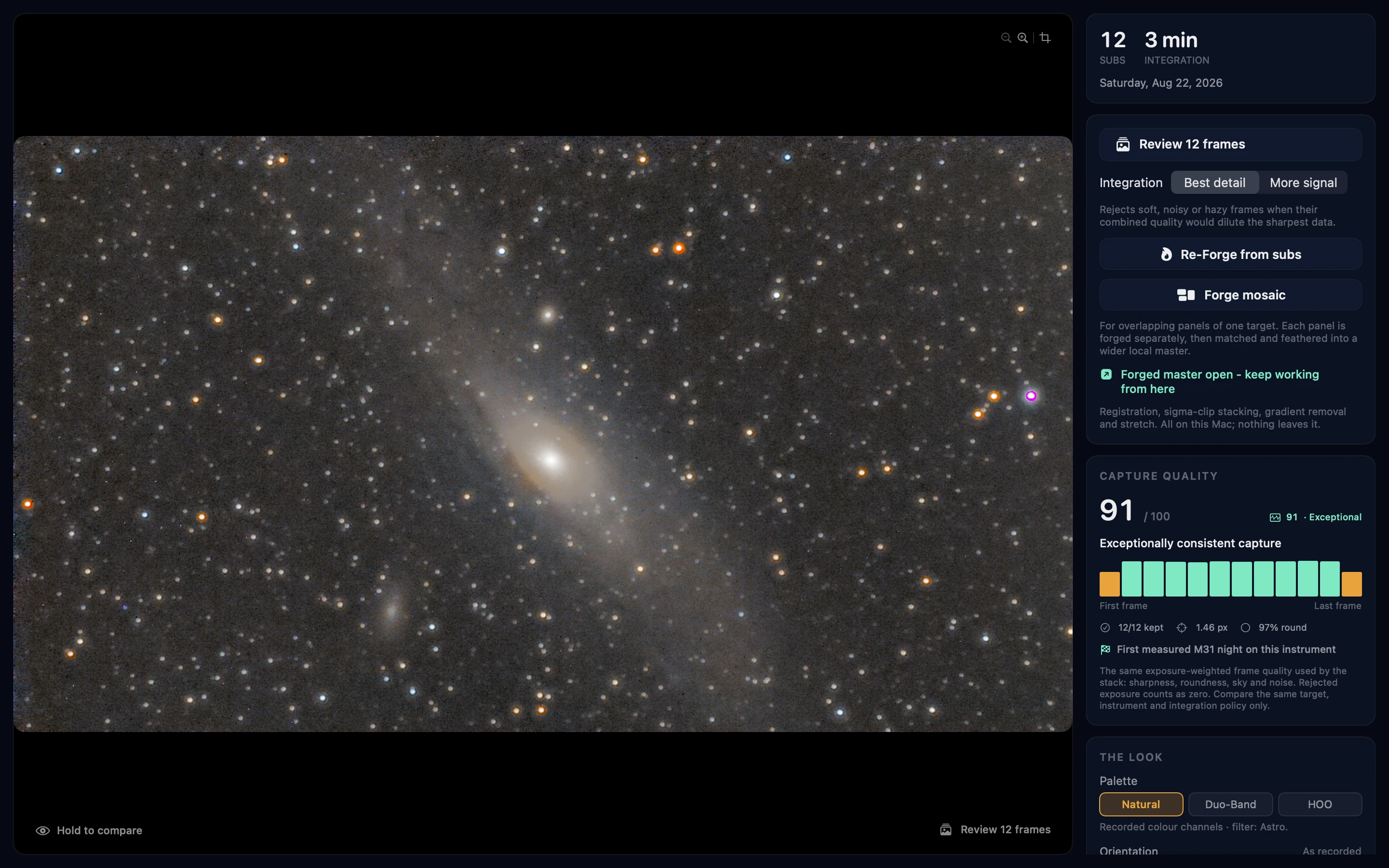
Frames, integration, and how the sky is behaving, in the corner of the screen you're already using. A notification when the night is done, because by then you're indoors, and one press turns the finished night into a picture.
Mission control
Both lenses live on the screen already on your desk, full resolution, with 1×, 2× and 4× and a sky you can drag. Pick a target and plate-solved GoTo puts it in frame. The tele lens's footprint is drawn on the wide view, so you can see what you're about to photograph before you commit the night to it.
Daylight plans too
Earendel calculates eclipses and satellite crossings for where you actually stand, then maps the narrow path where a solar or lunar transit is visible. Filtered-Sun telescope control remains an attended TestFlight field beta until its physical safety session passes.
Local. Always.
No cloud round-trip, no upload failed, no waiting on someone else's server to see your own photograph. Nothing leaves your Mac, and nothing needs to arrive: the two and a half million stars Earendel measures your colour against travel inside the app. Works on a hilltop with no signal, and will still work when someone else's API is retired.